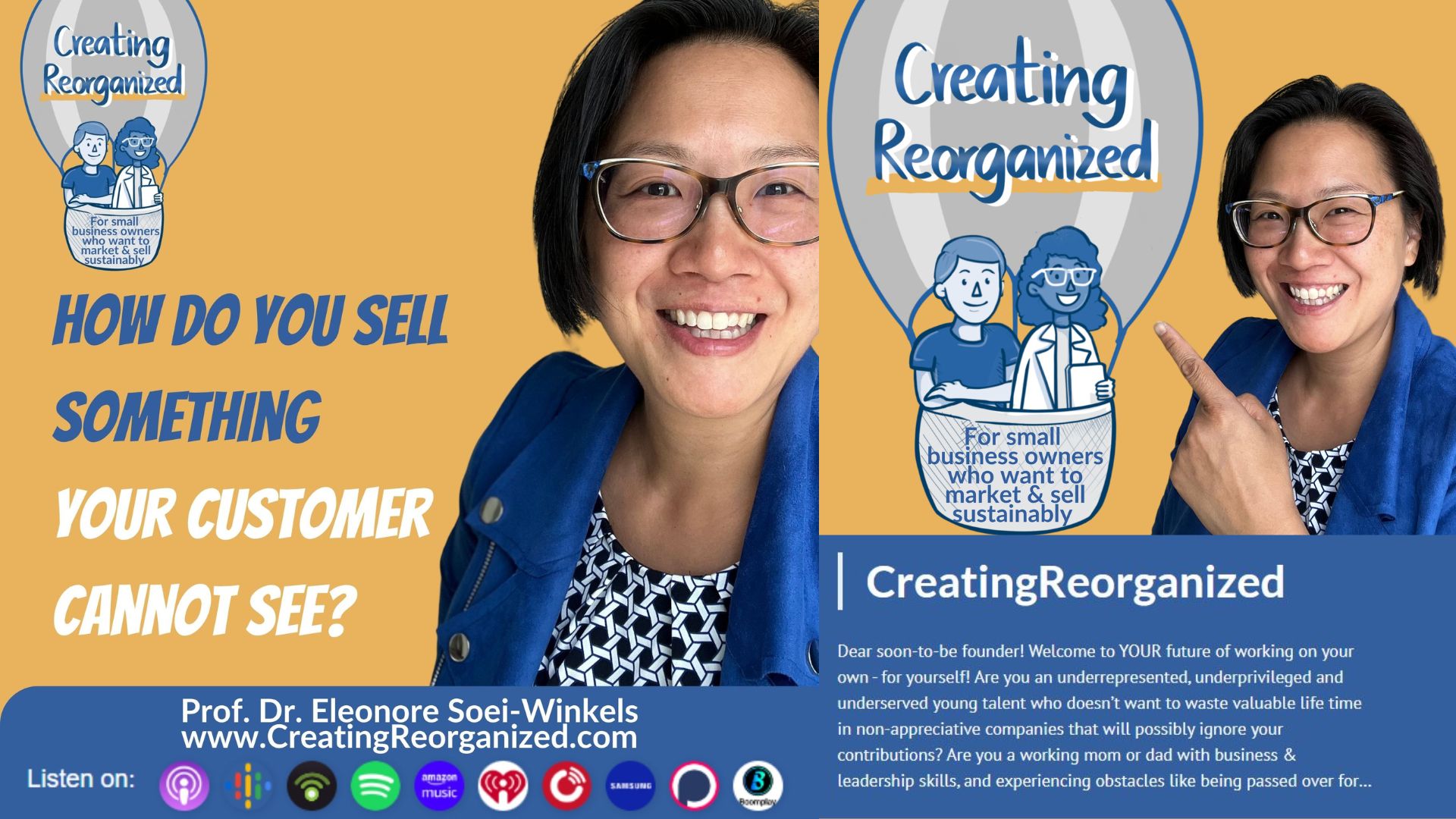
Make the Invisible Visible: How to Sell Intangible Services
Help buyers understand what they get, how delivery works, and what happens next. Use the Customer Uncertainty Map, service demos, and a practical offer audit.
With Prof. Dr. Eleonore Soei-Winkels · Descript master: 36:49
Executive summary
Have you ever trusted someone’s expertise and still hesitated to buy their service? You might have understood their credentials and still wondered what they would deliver, what they would need from you, or what would happen after you signed. I use uncertainty reduction theory as a lens for those unanswered questions and introduce my Customer Uncertainty Map to help you address them before a sales conversation.
You’ll hear how a consultant can use a sample deliverable, how a learning app demo can show what happens after a wrong answer, and how those explanations can become evergreen resources. To apply the ideas, ask someone unfamiliar with your offer to tell you what they would receive and where they still have questions.
The Customer Uncertainty Map
Prof. Dr. Eleonore Soei-Winkels introduces this framework as a practical application of uncertainty reduction theory to customer communication.
- Offering. What is the customer buying, what will they receive, and what is excluded?
- Process. How will the work unfold, how long does it typically take, and what does the customer need to contribute?
- Boundaries. What can you reasonably deliver, and what depends on the customer or their circumstances?
- Next steps. What happens immediately after payment or signing, and how does the customer get started?
Pick one offer. Ask a first-time reader to answer these four questions using your existing materials. Turn one answer they couldn’t find into a sample, walkthrough, FAQ, or onboarding message.
Listen to CreatingReorganized
Episode 27 is scheduled for 19 November 2026. These show-wide players let you browse CreatingReorganized; episode 27 will be available after publication.
Full episode transcript
Timestamps follow the approved Descript master, including its recorded ad-break announcements. Player times may differ when dynamic ads are served.
00:00:00 Why Customers Hesitate to Buy Intangible Services
[00:00:00] Imagine someone has heard you explain your ideas, they understand your professional background, and then they believe that you know what you're talking about. That's great, right? But they still don't purchase your service. Why? Because they don't understand what happens after signing the contract.
[00:00:21] They don't know what exactly they will receive or how much work they will have to contribute as well, alongside with you, or how they will know whether the service has delivered what was promised. So they don't know the key performance indicators to evaluate your service, and you have to give that to them, right?
[00:00:44] So imagine you're a consultant, a coach, a business owner selling a digital product. You might be excellent at what you do, but if customers do not understand what they are exactly purchasing, your expertise alone might not be enough. Because that is the interesting question here. What if the problem isn't your marketing reach?
[00:01:06] So being on social media, et cetera, is not enough. What if the problem is that your customers cannot see what they're actually buying? And today we're exploring how to make that intangible product or service of yours easier to understand, to evaluate, and to purchase. We'll learn how to turn these explanations into reusable business assets.
[00:01:32]
[00:01:54] Dear Creating Reorganizer, welcome to Creating Reorganized. this week, actually yesterday, we just surpassed 10,000 listeners that is not the most important KPI, but I'm so grateful to have you as one of my 10K listeners. You know that I'm a psychologist, and I want to understand how the brain works. I believe that understanding the brain will help you to build a bridge To understand your potential customers, to understand the market, and also to create a product or service that solves their pain points, their problems, whatever they want to solve as a problem.
[00:02:33] So what they are willing to pay a solution for. So that you can build a solution, deliver that, and also help them thrive in whatever they wanna do. So this Creating Reorganized show is right at the intersection between psychology and entrepreneurship.
[00:02:52] Every week, I translate, psychology, enterprise thinking, IT strategy into practical ideas that help you build a better business according to your vision of life. And I'm building my own business, family first, with AI in public, and I'm honored to take you with me.
[00:03:09] So in episode 26, we explored how you can make your professional expertise observable before the sales call, before the sales conversation, and we discussed how and why a potential customer needs ways to evaluate your competence. In episode 27, we now move one step further, because believing someone is competent doesn't necessarily mean that they wanna buy from you, right? So you might trust a consultant and still have no idea what their engagement includes. You might admire a coach without knowing what happens in a coaching session.
[00:03:53] So today, our focus is customer clarity, helping customers understand what they will receive, what they can expect, and what happens next, that you are reliable in delivering the service.
00:04:07 What Buyers Need to Know Before Hiring a Consultant
[00:04:07] Let's imagine you're a business owner looking for help with your organizational processes, and you find a consultant offering a business transformation program. The website promises efficiency, scalability, and sustainable growth. That sounds promising, right? You want that, of course. But what does business transformation actually mean? Will the consultant analyze your processes?
[00:04:33] Will they use a template? Will they use AI? Will they watch you doing something? Will they interview you? Will they interview your employees or recommend new technology? How are they maybe affiliated to that? Will they help implement the change and holding your hands while doing so? What happens after the project? Will there be a handover? Will you receive a written report? Will you have a roadmap, a dashboard to see whether you are performing well or is it simply a series of conversations? It's not stated what your service will be, and that is why your potential customer doesn't know. And now imagine another consultant is offering a similar service, business transformation. But this consultant explains the engagement in four steps.
[00:05:26] First, an initial diagnostic conversation. Second, an analysis of the existing processes. Third, a presentation of recommendations, and fourth, a discussion of implementation priorities. And that website may even include a sample deliverable, perhaps a fictional process map or an example of a decision matrix.
[00:05:52] Now, when you compare both offers, which offering would be easier for you to understand, to evaluate whether you need one or not? And if you're honest, it's probably the second. Not necessarily because the consultant for the second offer is more competent, but because you understand what you're purchasing, and that distinction matters.
[00:06:13] Let's consider a coach. A six-month program might promise professional growth and greater confidence. But customers still wonder how often they meet the coach. Weekly, bi-weekly, monthly, on demand? They might ask what happens between sessions and what they can reasonably expect. Or imagine purchasing software. You might understand the features on the website, but still wonders what happens when you subscribe, how difficult is the setup, and what support is available? What happens if it's not a good software fit to your needs, these aren't necessarily objections to the product. They're just unanswered questions. When we leave those questions unanswered, we're asking customers to make decisions with incomplete information.
[00:07:06] So let's bring in the psychology.
[00:07:08] In 1975, Charles Berger and Richard Calabrese introduced the uncertainty reduction theory. Their work examined communication during initial interpersonal interactions. One important idea is that people often seek information when they're uncertain about others. they don't know, is that person good or bad?
[00:07:31] The service is good or bad, the product, whatever, right? So now the theory wasn't originally developed to explain customer purchasing behavior, but it applies here too. I'm not suggesting that it directly predicts whether someone will buy our product, but I find it really useful as a perspective for thinking about unfamiliar business relationships, because that is the situation that we have at hand, right?
[00:07:58] Purchasing a professional service often involves uncertainty. So you look for information, indicators.
[00:08:06] Perhaps you read customer reviews, you ask questions, you can compare providers, or you request a sample, a trial. But here's something important: not all information are equally useful. Imagine you are uncertain about what's included in a consulting package. Would another podcast episode about the consultant's professional qualifications solve that problem?
[00:08:33] Probably not. You need information about the package, and if you're uncertain about the delivery process, you need an explanation of what happens after purchasing. And that is why I want you to distinguish between those two questions. The first is: Can I trust this person's professional competence?
[00:08:51] If you don't know what I'm talking about, listen back to episode 26. The second one is, do I understand what I'm purchasing? So these questions require different answers, okay?
00:09:04 The Customer Uncertainty Map: Offering, Process, Boundaries, Next Steps
[00:09:09] Now let's make it practical. I wanna introduce a framework that I call the customer uncertainty map, and it's a direct application of the theory we have just discussed from Berger and Calabrese.
[00:09:17] It helps us identify the information customers need to make an informed purchasing decision. It's four parts. First, the offering. What exactly are you selling? What's included? And also equally important, what is excluded? So within beyond limits. And what will the customer actually receive? Think about how many businesses describe their services using abstract terminology: transformation, empowerment, optimization, growth.
[00:09:54] These nouns communicate aspirations, but they don't necessarily explain the offering. It's intangible. I cannot touch that. We cannot say when optimization has started and stopped, how empowerment looks like, how it feels like.
[00:10:11] second is the process. What happens after the customer purchases? What are the main steps? How long does this process typically take, and what does the customer need to contribute? For example, a consultant might require access to certain business information, so if that information is not provided, what happens to the service?
[00:10:36] There's no ground for the service if the information is not delivered by the customer. Does the customer know about that? A coach might ask clients to complete exercises between sessions. It's like my students, right? Before they take the exam, I require them to do all the exercises before, and I know that if they do not complete them by themselves, well then chances are quite low that they will ace my exams.
[00:11:03] it's on me to tell them they should do them, but they are adults, right? So that's my service. If they don't do it, then my service at the end of the day will also be mediocre. So I want to vet my students as you want to vet your potential clients as well. You need to qualify your potential customers, right?
[00:11:23] Next example is, a software provider might require customers to configure an account before they can use the product. That is a really important prerequisite. Without that, we cannot continue. So what you need to do is to, before the purchase, communicate and making those requirements clear so that the potential customer knows what is their responsibility in the solution of this problem.
[00:11:51] Making those requirements clear helps you establish realistic expectations that you can manage and also meet as the service provider. Third, the boundaries. What can your product or service reasonably deliver and what not?
[00:12:10] A consultant can provide recommendations but cannot do magic, right? implementation may depend on decisions made by the client, and a coach can support professional development, but, you know, coaching does not guarantee promotion when it's about careers. An educational application like my apps can provide additional practice, yeah, but it does not guarantee a child's improvement in grades. We need to distinguish between what our products or services can achieve and what not. And then fourth is what should the customer do if they're interested to purchase? Request a demo, try a sample, book a discovery call, or purchase directly?
[00:12:55] And what happens immediately after that?
[00:12:58] These are the four parts of the customer uncertainty map directly derived from the theory. Number one, the offering, number two, the process, number three, the boundaries, and then fourth, the next steps. Now, you don't need a sophisticated app to apply this framework.
[00:13:18] It's really that simple. You can start with your existing website. Look at that and review whether a potential customer can find clear answers to these four questions.
[00:13:28] Let's pause quickly to appreciate those who sponsor this valuable episode
[00:13:32]
[00:13:37] After this quick appreciation of our sponsors, we are now back in our insightful episode
00:13:42 How to Show What a Consulting or Coaching Service Delivers
[00:13:42] Let's explore how this works in different businesses. Again, you are a consultant specializing in organizational development. You can create a sample deliverable, perhaps a fictional organizational analysis. One example of how you map responsibilities across departments, and the customer needs to understand that a typical deliver could look like this. Now imagine you are a leadership coach. So you could explain the structure of your coaching program. Is it a one-day retreat?
[00:14:15] Is it a two-week program? Perhaps you can provide a sample exercise or show how clients prepare for a session. And you have to explain also the boundaries of your service, right? What your coaching includes and whatnot. You could also share examples of your materials that participants receive. You don't need to give away 100% for free, okay? You're simply making the offering easier to evaluate. You're giving a sample, not the full 100%. And if you want to know, here's one episode that I created a couple of years ago actually about, free content versus paid offers, the best business mix.
[00:14:58] So you can listen back to that. That is episode six, free content versus paid offers, the best business mix, and I will link to that in the show notes
[00:15:07] And back in this episode, this is where video can be particularly useful. You can use slides or show how the deliveries look like for example, I use Descript to edit my podcast recordings and videos, and after recording, I let Descript's AI support the initial editing process so that I can pull into, B-roll material that I wanna show as an example, as a sample of the material that I'm using for my coaching services
[00:15:38] so you could use your video podcast like this so that you, by the way, show what your customer can expect. And then while I edit that, I review and refine the content myself, and I only work on words. I used to edit also sound waves, but today I'm just using the words as a marker, and then I listen back.
[00:16:02] But that is like doing only the 10% that I really enjoy, and 90% is done by AI in Descript now. And of course, I've connected Descript also to ChatGPT through my MCP, so the Model Context Protocol, to explore more integrated production workflows. So I can, edit from my phone when I'm waiting for my kids exercises. You don't need to do that in your production process, but you can make the best out of your time, okay? And then along these lines, you can just reuse material that you have already recorded. I've previously published a Creating Reorganized episode about creating a demo video in Descript. I did that two years ago, and I've done this in the last episode, the bonus episode about Metricool, right?
[00:16:54] And I link to both of these episodes in the show notes so you can see how I do a walkthrough, so that you can see what I do, how I work. I'm done with showing what I can do, right? Because sometimes the most useful marketing isn't, you know, another advertisement. It's a clear explanation of what customers can expect. Showing a demo of the video, showing a demo of the app or whatever.
00:17:21 How to Demo Learning Apps and Educational Podcasts
[00:17:21] Now, let me share how I am applying this idea to my own business. Like I said, I'm taking you with me. So I've been developing education learning applications, apps initially to support my own children's learning. And I'm exploring currently whether similar products could be valuable to other families.
[00:17:39] I'm currently reaching out to potential sponsors and also third parties that are interested in supporting my ideas. For example, I've developed WordWise for vocabulary practice, for learning English numbers or for listening comprehension and reading comprehension, and also other subject related learning. I could see myself describing WordWise to another parent. I could say it's an interactive vocabulary training like I'm just doing now, but when I now show you videos like this, how it looks like, how it behaves like this, and I will include some of the videos that I have recorded while doing, while working with the app.
[00:18:23] That will help you understand what the product, the app is. If I just explain it, then a description leaves important questions unanswered. Because the questions are for me as a mom, if I would be evaluating whether I would need to buy an education app is like, can the child practice independently? What happens after an incorrect answer?
[00:18:50] So instead of simply describing it like I do now, I'm not showing you an app. Now, I will also demo the learning experience by showing that video. See the difference before and after, right? So I could show how children practice distinguishing between English numbers that are easily confused, in German, these are even reversed. I could show an example of my advent calendar for electricity and energy, but also reading comprehension like this.
[00:19:28] Now, those demos help parents understand what these applications can do, but I also need to explain what they don't do. They're not a substitute for teachers. Teachers are still needed, but showing that an app functions as intended does not establish what it improves.
[00:19:46] what would be the outcomes of that? That is a separate question requiring an appropriate evaluation. As you know, I'm also exploring personalized learning podcasts. I'm creating German-German podcasts, talking in German about German grammar, but also I'm doing German podcasts explaining English grammar.
[00:20:08] So for all of these, the customer experience is different. Parents might want to know how long these episodes are, which subjects are covered, how the audio is delivered, and whether the content matches their child's learning needs. I need to explain the product differently to another product that I offer.
[00:20:28] It's totally different to apps. Because an interactive application and an audio learning program are not the same experience. Shall I just show someone who is listening to my podcast? Well, that would be boring. No interaction, right?
[00:20:42] But even if they address similar educational challenges based on the product, based on the service, your implementation of how to demo your service needs to be differentiated. Once I have created these demos, I can distribute them across my social media channels. For that exact use case, I have already created some TikTok videos of glimpses into my apps so that you can see them here, and you see that they spark interest.
[00:21:13] When I look at now into the search bar, then I see that the app names I've teased are also popping up in the search bar. So that works. I'm creating a sparked interest, so to speak and if you want to know how I know that this is the type of content that works for me, well, I use Metricool for planning, scheduling, and also analyzing my content. And because I am a happy Metricool user, I've also recorded a bonus episode comparing Metricool and SocialBee for different business use cases.
[00:21:49] So if you're deciding which platform might fit for your content management and scheduling workflow, you'll find that comparison in the show notes below here. But, my objective isn't simply to generate views. That is important, yes, but it's also key for me to find the right customers, understand the right offering, because That is a different measure of success.
[00:22:12] I don't want to have a broadband reach, but instead, I want to target the right audience.
00:22:20 What Podcast Downloads Reveal About Audience Reach
[00:22:20] So now speaking of making something invisible, visible, I wanna share a little milestone with you. Creating Reorganizers, you have chose to spend some time with me, so I absolutely am honored to have been, and now are, in your earbuds. With over 36,000 podcast downloads. And I wanna thank you for being part of my journey, because to me, podcasting can feel surprisingly intangible.
[00:22:53] I record an episode, I publish that, and then I return to my other responsibilities like teaching, researching, running my business, and of course being a mother.
[00:23:04] So I don't see every person who listens. I don't know. And I'm actually not so much promoting my shows to my students, it's also like it's there, they know, they should not feel pressure to listen. So having you as my listener is absolutely mind-blowing for me. I don't know what you as a listener take away from an episode.
[00:23:32] I don't get so many reviews or DMs. If I ask to, yes, but, know, it's an ask. It's not coming directly. And I certainly don't see every business decision that might be influenced by something we discussed here.
[00:23:48] I mean, you don't tell me what you change in your business, right? So these download numbers, these listener numbers make this part of the invisible activity visible for me. They show that my show is reaching you, and I wanna be careful about what those numbers actually mean. A download isn't the same as a listener, and neither one of them automatically tells me whether you have applied an idea or become my customer.
[00:24:16] I know that from social learning that applying something that you have learned may happen later down the road, and that does not diminish my teaching to you, right? So I don't know whether you have achieved a business outcome because of my show, but still the numbers provide evidence of distribution and also audience development, and that is meaningful because I'm building Creating Reorganized around my own family first working model. My last season three has been, , in May, I think, and now we're approaching November by the time that I will publish that.
[00:25:00] So the thing is, my seasons are shorter than my season breaks And that is because I'm doing evergreen content, and my numbers prove and attest to that, that you should also take the time to create something that helps you having a greater impact than without it, and to make the most of that impact and the most of that effort So I'm not publishing content around the clock.
[00:25:28] I'm scheduling that out via software, Metricool. I'm creating resources that can continue reaching people long after I have finished recording them, and that is why I'm so bullish about creating evergreen content.
[00:25:44] So thank you for listening, and thank you for helping making my journey also visible.
[00:25:49] Let's pause quickly to appreciate those who sponsor this valuable episode
[00:25:53]
[00:25:59] After this quick appreciation of our sponsors, we are now back in our insightful episode
00:26:03 How to Turn Customer FAQs and Demos Into Evergreen Assets
[00:26:03] Now let's return to your business again, because the same principle applies.
[00:26:08] So when something important is difficult to observe, you need to ask yourself what evidence would make it easier for your potential customer to understand? But always distinguish between what your evidence shows and what it doesn't, right? So let's connect this to the broader season four storyline.
[00:26:30] Because once you have created a useful explanation, it does not have to vanish or disappear after one social media post. You can turn it into a reusable business asset because it helps customer A to understand, and maybe in six months time, also customer B, right?
[00:26:51] Thinking of frequently asked questions, imagine you run a consulting business. Potential customers may ask you always the same kind of questions, one, two, three, and b- blah, blah. So instead of sounding like a broken record, you could record answers to the following questions: What does your service include?
[00:27:16] How long does this engagement take? What will they receive? What happens after the project? Instead of answering every question individually, you can create a small customer clarity library, and maybe it also even includes a sample delivery, a short explanation of your service process, and an FAQ, frequently asked questions, of course.
[00:27:38] And maybe even you just go beyond that and create an onboarding guide, and that helps your potential customer decide whether they want to walk with you over that bridge, because they see the bridge, they see the land they can reach, and they know that bridge is stable, and it has some guardrails, so you will be holding their hand.
[00:28:04] Hmm? So that looks so much more reassuring than, "I don't know how we will get there." So all of these resources you can provide beforehand once and reuse again evergreen, these resources can serve several purposes. One is they can help potential customers evaluate your offering.
[00:28:28] Second, they can help existing customers to understand the next steps. They can help employees even understand your business promises so that they know how they can take over work from you and be the guide on the bridge, because you don't wanna be the bridge at all the same time, right?
[00:28:48] Because your job is maybe to get new people going over that bridge. Hmm. So they're not simply marketing materials. They are resources that support the customer relationship, and in my early days in IT, I was also creating materials to customer support teams so that they are equipped in creating a better customer support.
[00:29:12] And that is where I learned about systems for your customer relationship management, and that is the reason why I also use a CRM, customer relationship management tool, like ActiveCampaign. I use it for my customer relationship management, also for my marketing automation. For example, when appropriate consent and configuration in my emails has been done, I can provide relevant information to someone who has expressed interest in a product or service.
[00:29:43] Perhaps they receive a sample of my career coaching maybe they get an explanation of what happens after purchasing, an onboarding sequence could help customers how to get started, but only if they are clicking on the right link, clicking on the button. I have set up my ActiveCampaign to be triggered by link or button clicks that express a certain interest, and then from there on, there is a path for A, B, or C, right? Maybe it sounds complicated, and I'm not saying that every business needs a complicated automation. Sometimes a clear confirmation by hand is enough, but you need to provide that clear confirmation of what happens next, right? So these four steps of the uncertainty theory map you need to apply.
[00:30:33] You just have to communicate that. Not communicating is not enough. The principle is important. You can design customer communication so that people receive information that is useful for them at that point of time when they need it, without having to ask for it repeatedly.
[00:30:52] Make it frictionless, make it easier for them. Make them not think about and doubt that you are the best solution for that, right? And that makes this business more manageable. And I will include links to the tools I've mentioned in the show notes. Some are affiliate links, meaning I may receive a commission from qualifying purchases at no additional cost to you.
00:31:18 How to Audit Your Offer for Customer Clarity
[00:31:18] I wanna give you a practical experiment. Choose one product or service you currently offer and imagine you're encountering it for the first time. Ask your best friend to be a friendly tester. You don't know the provider. You haven't experienced the product or service, and you don't know the internal processes.
[00:31:39] Now ask yourself four questions: Number one What exactly am I purchasing? Two, what happens after I purchased? Three, what are the limitations? And four, what should I do next? It's just what we have just discussed. Then review your website. Can a potential customer find those questions?
[00:32:01] Can a potential customer finds those answers? Are these answers understandable? If something is unclear, choose one answer you need to address. Perhaps you can create a sample deliverable. Explain your pricing more clearly, and record a short video showing what happens after someone subscribes.
[00:32:22] Then you can ask a few potential customers to review it don't simply ask whether they like the content. Ask what they have understood, what remains unclear, and what information they would still need before deciding whether the offering is right for them.
[00:32:39] We're not trying to persuade everyone to purchase. We're trying to help the right customers make the right informed decisions so they can buy from us. We're also trying to learn whether our communication actually represents what we deliver, because we don't wanna promise something that we can't deliver.
[00:33:00] Here's one more thought for your business. When potential customer is hesitant, what do you assume is causing the problem? Perhaps you think you need more advertising, more social media content, or a more sophisticated sales funnel. But could be, doesn't have to be.
[00:33:20] What if the problem is simpler? What if people don't understand what you're offering? I'm not suggesting that clearer communication will solve every purchasing problem, but customers also consider price, alternatives, time, and their own needs. But before investing into more marketing technology and more marketing content, et cetera, I think it's worth asking whether your existing customer journey is clear.
[00:33:49] And for me, this connects to my vision of life. As a professor, entrepreneur, and mother, I have limited working hours, so every hour that I invest into the wrong problem-solving will take time from the right problem-solving, so I wanna use my hours where they create meaningful value. I don't wanna spend them repeatedly explaining information that could be made available through a clear website, a demo, or an onboarding process.
[00:34:22] And I don't want to create more unnecessary complexity. Customer clarity is part of building a more sustainable business because when customers understand what they're purchasing, and when expectations are established early, well, I can deliver what I have promised.
[00:34:40] There's no bad surprise, and bad surprises are actually often, um, a case for customer complaints, which takes time. you don't want that, right? So of course, good communication doesn't replace good service delivery, a good product, but that's where our next episode is coming in, right? So let's bring this together.
[00:35:00] Today, we have explored why customer may hesitate even when they trust the person offering a service .We looked at the uncertainty reduction theory as a useful perspective on unfamiliar interactions, and we introduced the customer uncertainty map as an application of the theory.
[00:35:19] Those four areas are, one, the offering, two, the process, three, the boundaries, and fourth, the next steps. Now, remember how this connects to a previous episode. In episode 26 of the Creating Reorganized show, we explored how you can make your professional expertise become observable, how potential customers can evaluate your competence before the sales conversation.
[00:35:46] And today, in episode 27, We move from professional credibility to customer clarity, because even when customers trust your service and trust your expertise, they still need to know what they're purchasing. And once you've made that clear, another question emerges that I want to address in episode 28, which is, can your business actually deliver what you have promised consistently and without you becoming the bottleneck? We'll examine how to make responsibilities, decisions, and service processes even more visible, because making a business understandable to customers is one thing, but making it manageable behind the scenes is another.
[00:36:30] And both matter if you want to build a business that supports your vision of life. I'll see you next week. Happy creating reorganized according to your vision of life.
[00:36:39]
Frequently asked questions
How do you sell an intangible service?
Show what buyers will receive, how delivery works, what they need to contribute, and what happens after they buy. Use a sample deliverable, demo, or walkthrough to make those answers concrete.
What is the Customer Uncertainty Map?
It is Prof. Dr. Eleonore Soei-Winkels’s four-part framework for making an offer clearer. It covers the offering, the delivery process, the boundaries of the work, and the next steps after purchase.
How can a consultant demonstrate value before a sales call?
Use a fictional sample deliverable, such as an organizational analysis or roadmap, to show what the client can expect. Explain which decisions it supports and what inputs the client needs to provide.
What should a learning app demo show parents?
Show how a child starts, practices independently, and gets feedback after an incorrect answer. A walkthrough can demonstrate how the app works. Evidence of learning improvement requires an appropriate evaluation.
How can I test whether my offer is clear?
Ask someone unfamiliar with your business to review the offer and explain what they are buying, how delivery starts, what is included or excluded, and what happens after purchase. Use their unanswered questions to revise the page.
Research and further listening
Berger and Calabrese developed uncertainty reduction theory to explain communication in initial interpersonal interactions. Episode 27 applies that perspective to questions buyers ask when evaluating an unfamiliar offer.
- Episode 26 | Make your expertise observable before the sales call
- Episode 28 continues with how to deliver consistently without becoming the bottleneck.
- Browse the CreatingReorganized episode archive
Tools and walkthroughs mentioned
Descript · Metricool · ActiveCampaign
Watch my Descript making-of video or read the walkthrough transcript.
AI transparency
I use ChatGPT, connected to ActiveCampaign, Metricool and Podbean, to help inform the seasonal story arc and individual episode storylines for CreatingReorganized. I guide the editorial direction, review the suggestions and remain responsible for the final content. ChatGPT is part of my production workflow; this mention is not an affiliate recommendation or paid sponsorship.
Commercial transparency
The Descript, Metricool, and ActiveCampaign recommendations include affiliate links. I may receive a commission from qualifying purchases at no additional cost to you. The transcript includes the recorded announcements around advertising breaks.